VENICE--Enrica Rocca, native of Venice, resident of London, returns to her handsomely appointed loft in the Dorsoduro and gives cooking pointers to paying guests. "The recipe," she says offhandedly, "is a modern concept."
Is this serious advice or another example of the Italian gift for stylish improvisation? "Just put good things in, good things will come out," she continues. Were this truly the case, she'd be out of work. But she continues: "The ingredient most often lacking is common sense."
And there, in a nutshell, is the reason for cookbooks, for the popularity of TV cooking shows and glamorous cooking-school vacations (a business I've got a stake in, truth be told): a lack, not just of common sense but of confidence.
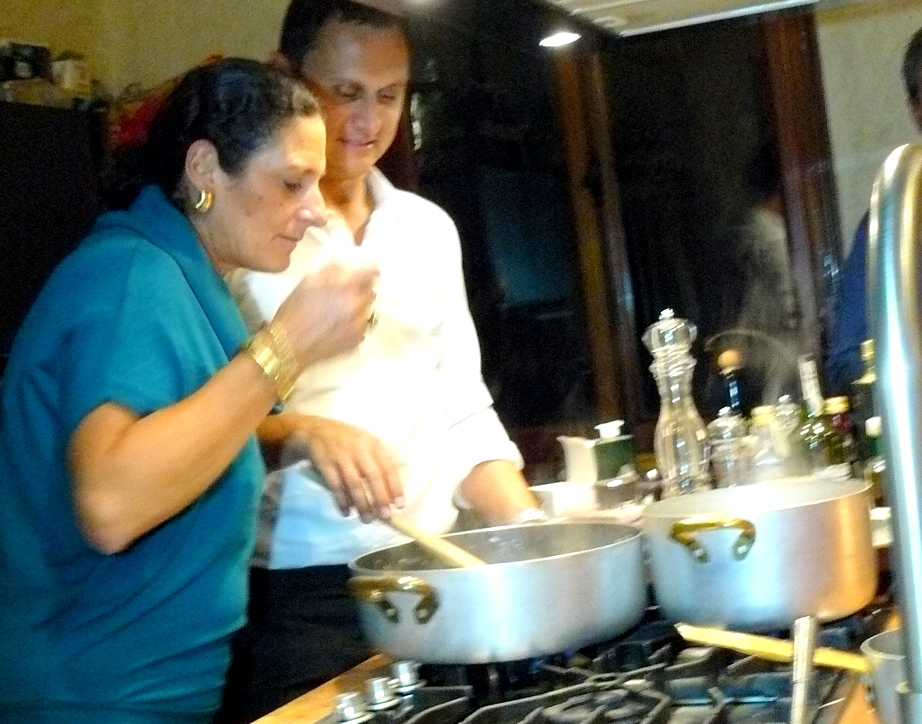
We're in what used to be the laundry of her family palazzo, a short walk from the Accademia bridge. A butler in a tuxedo pours prosecco while Enrica and a couple of volunteers help with the risotto. Carnaroli, not arborio rice, two to three ounces per person. Put the porcini mushrooms in first, so their flavor penetrates the rice. Use stock made from prawn heads, where the flavor is. Add the prawns themselves at the last minute so they don't overcook. Stir in some wild mint and lemon zest, along with a touch of heavy cream, and let the risotto stand, covered, for five minutes before serving. We sit on stools covered with the hides of springboks, dyed bright orange, and the prosecco gives way to a Soave.
We--a coterie of international tour operators--been invited to this impromptu dinner as part of a travel project called PLANETT, Private Luxury Accommodation Network, designed by Marco Giol (the very well-connected man with the motor launch described in this post) to showcase the very best of a private, hidden Venice that most tourists will never see:. a private palazzo on the Grand Canal, a private castello in the vineyards, that sort of thing.
Enrica worries about culinary programs that promsie to teach "how to cook" in one day. ("Pretentious bullshit.") Instead, four basics: qualty ingredients, take the time to shop, read the labels, and remember that the very act of eating is fundamental. Then go fot it. "And if you fuck it up, that's what takeout is for."
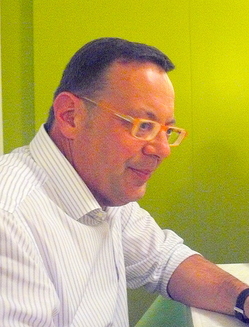
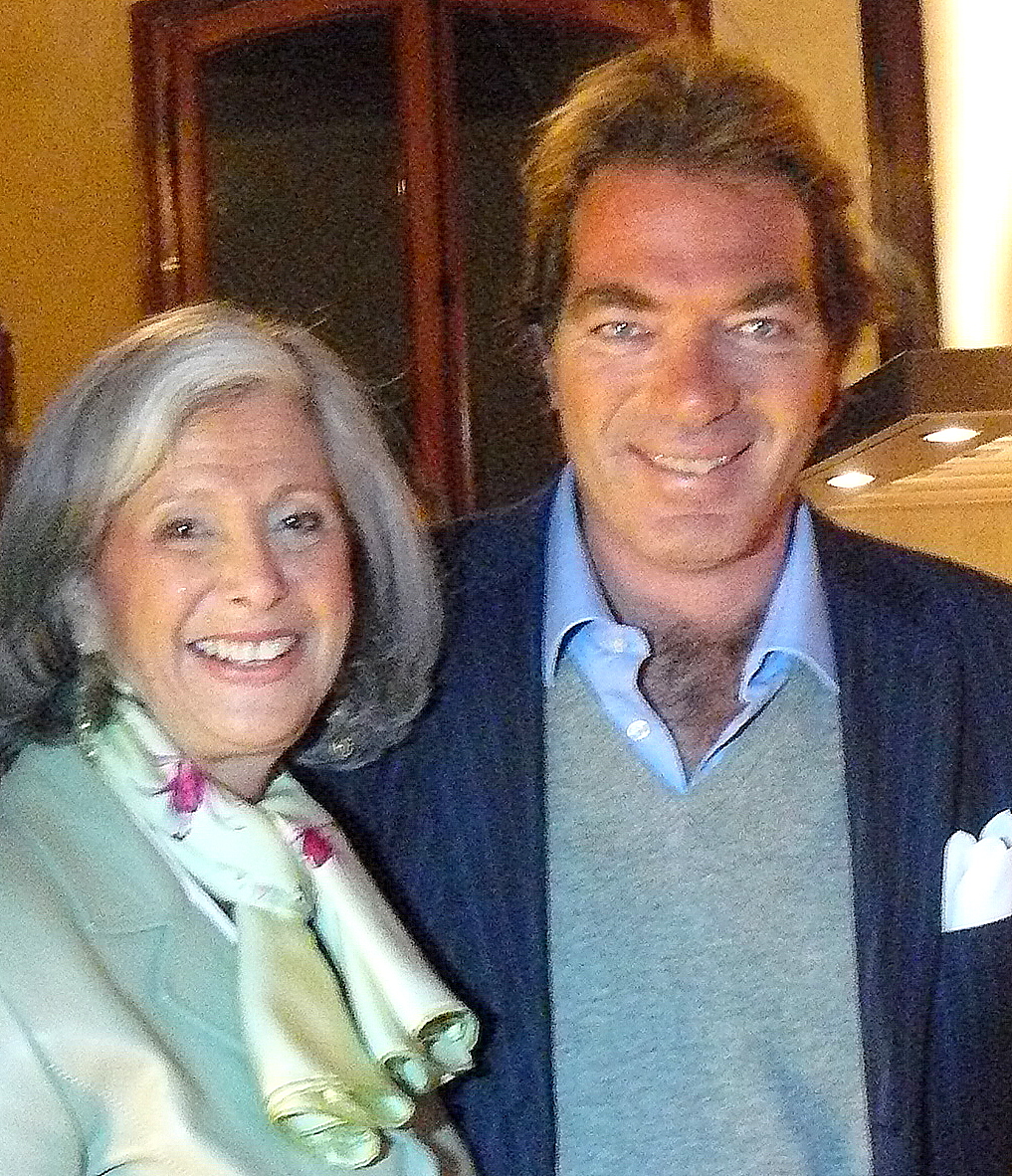
Top: Enrica Rocca checks the risotto. above, Marco Giol with Karen Herbst of The International Kitchen.
Monday, October 24, 2011
Monday, October 17, 2011
Italy in Mind
Sunday lunch at a farmhouse in the countryside 90 minutes southeast of Rome. It's almost a cliché, a scene you've watched in countless movies; just close your eyes and imagine the scene.

There are long tables under a pergola, there is sunshine, there is a medieval hilltop village in the distance. There is music (a gent playing a rustic bagpipe called zampogna), there is the cheerful sound of children playing soccer, there is wine, and, of course, there is food. A seemingly endless procession of food!
Assorted antipasto plates to start: slices of prosciutto and coppa, fresh ricotta, an older ricotta salata, home-baked bread, roasted peppers, a frittata, a potato salad, grilled eggplant, bruschetta with fresh tomatoes, bruschetta with arugula and cheese, cannellini beans...I confess to losing track.
Then comes pasta. Pacchetti (wide noodles stuffed with cheese, baked in the oven), strozzapreti amatriciana (thick noodles--priest stranglers--in a tomato sauce with guanciale, pork jowl), oricchietti (shell-shaped pasta) with artichoke hearts.

Then a couple of local specialties, braised goat (utterly delicious) and lumache, snails in tomato sauce (you pull the meat out with a toothpick).
Finally, some cookies for dessert. This was at an agriturismo (farmhouse inn, two guest rooms and a restaurant that uses almost exclusively the production of its own land) called Il Rusponte.
The price for the feast, which included a carafe of house red and a shot of house-made grappa with the coffee, all served by cheerful waitresses, was 35 euros per person (about $50), everything included. If you'd had a similar meal in a big-city restaurant, you'd pay three or four times as much.
The zampogna guy, on the other hand, was freelance. He showed up and played for the fun of it, then passed around his hat. Wake up? Surprise, you were awake the whole time!
- Posted using BlogPress from my iPad
There are long tables under a pergola, there is sunshine, there is a medieval hilltop village in the distance. There is music (a gent playing a rustic bagpipe called zampogna), there is the cheerful sound of children playing soccer, there is wine, and, of course, there is food. A seemingly endless procession of food!
Assorted antipasto plates to start: slices of prosciutto and coppa, fresh ricotta, an older ricotta salata, home-baked bread, roasted peppers, a frittata, a potato salad, grilled eggplant, bruschetta with fresh tomatoes, bruschetta with arugula and cheese, cannellini beans...I confess to losing track.
Then comes pasta. Pacchetti (wide noodles stuffed with cheese, baked in the oven), strozzapreti amatriciana (thick noodles--priest stranglers--in a tomato sauce with guanciale, pork jowl), oricchietti (shell-shaped pasta) with artichoke hearts.
Then a couple of local specialties, braised goat (utterly delicious) and lumache, snails in tomato sauce (you pull the meat out with a toothpick).
Finally, some cookies for dessert. This was at an agriturismo (farmhouse inn, two guest rooms and a restaurant that uses almost exclusively the production of its own land) called Il Rusponte.
The price for the feast, which included a carafe of house red and a shot of house-made grappa with the coffee, all served by cheerful waitresses, was 35 euros per person (about $50), everything included. If you'd had a similar meal in a big-city restaurant, you'd pay three or four times as much.
The zampogna guy, on the other hand, was freelance. He showed up and played for the fun of it, then passed around his hat. Wake up? Surprise, you were awake the whole time!
- Posted using BlogPress from my iPad
Location:Castro die Volsci, Forsinone
Saturday, October 8, 2011
Harvest Dinner in Italy
Seems like everybody's opening a restaurant this month in Seattle, and everybody who's already got a restaurant is promoting a harvest dinner. You want a real harvest dinner? Try this: a seven-course game, truffle & mushroom feast.
What's the big deal, you might ask? Well, here's the translation:
- crostini with mushroom & game pâté
- egg & parmesan flan with black truffles
- pasta with more truffles
- risotto with porcini
- roast suckling pig with forest mushrooms
- wild strawberry tart
- coffee with homemade liqueurs.
It's being held at the restaurant of a working farm, the Borgo del Riso, in the fertile Po River Valley 20 miles outside Bologna. Might be too late to get there this season, unless you don't mind shelling out two grand in last-minute airfares, but the rooms are only $65 a night once you arrive. And there's a lot to see nearby: the gorgeous "art cities" of Emilia-Romagna, Parmigiano dairies, Prosciutto farms, and one of the world's largest radio telescopes.
Some of those sights below, from a trip with the Italian Tourism Promotion Council back in 2006.
Me, I'm actually going to this one in Lazio, a cooking school called Casa Gregorio, an hour outside of Rome, next week. Promise to keep you posted.
| Wheel of Parmigiano cheese |
| Baptistry ceiling in Bologna |
Sunday, September 25, 2011
Historic gnocchi at Festa Italiana
Garibaldi is a hero in Italy, the military commander who, in 1861, "unified" the 20 regions of Italy and helped create the modern state. He's especially beloved in Sicily, for it was a single victory at the western port city of Marsala that made his reputation.
The strands came together this afternoon, when Enza Sorrentino, a native of Marsala, took the stage at the annual Festa Italiana at Seattle Center and prepared red, white and green gnocchi, the colors of the Italian flag.
Her restaurant on Queen Anne, Enza Cucina Siciliana, had come to the attention of Rossella, whose real mother and grandmother had helped her win an episode of the Food Network's "24 Hour Restaurant Battle" earlier this year. So Rossella made Enza, who has five grandchildren of her own, her honorary nonna of the day.
The most remarkable thing may be that Rossella is only 23. She has poise and wit, charm and an unflappable stage presence, and, even more appealing, a profound respect for the wisdom of grandmothers everywhere. We're going to see a lot more of her.
- Posted using BlogPress from my iPad
Location:1st Ave N,Seattle,United States
Monday, September 19, 2011
My Sandwich, Your Sandwich
We know that there's more to sandwiches than ham on rye, more than even the fanciest, shmanciest burger. (In case we forgot, the Wall Street Journal this morning had a terrific reminder of great sandwiches around the country.) The street food of Sicily, or Vietnam, even a New Orleans po'boy: that's where the flavor is.
The sandwich in the picture? From a vendor in the Vucceria market of Palermo, Sicily. It's spleen. Like all organ meats, full of goodness.
Thursday, September 15, 2011
Mollusks of the Mediterranean
An informal group of Seattle restaurants was again promoting wild Alaska salmon from Bristol Bay earlier this month, with the argument that eating salmon is the best way to protect the endangered salmon runs. Similarly, eating local shellfish in the Mediterranean provides a reliable demand for the shellfish growers.
VENICE--The Mediterranean Sea -- under a million square miles, barely a mile deep -- is tiny compared to the world's great oceans. (The mighty Pacific is 65 times as vast, three times as deep.) It's as placid as a big lake, teeming with aquatic life -- 250 species of shellfish alone.
Along the Mediterranean coast of France, boats set out nightly to catch rockfish and eels for the local bouillabaisse, while oysters grow on the rocky reefs west of Marseille. Along the coast of Sicily, they go for prize swordfish, bluefin tuna, grouper, anglerfish, mullet, and sardines. Octopus and cuttlefish are everywhere. And in the northern Adriatic, where the Mediterranean dead-ends between the east coast of Italy and the west coast of Slovenia and Croatia, there's a thriving business cultivating shellfish (mussels, clams, oysters, scallops), especially in the shallow lagoons between Venice and Trieste.
Aurelio Zentilin.JPGWith a PhD in marine biology, Trieste-based Aurelio Zentilin runs the marketing arm of a thriving shellfish cooperative and writes an entertaining blog about mollusks. Fluent in Italian and French, he also hosts a YouTube series titled "Mollusk TV" that provides down-to-earth advice on selecting and cooking shellfish. Restaurant professionals regularly invite him to their gatherings, where he willingly shares his expertise and his recipes.
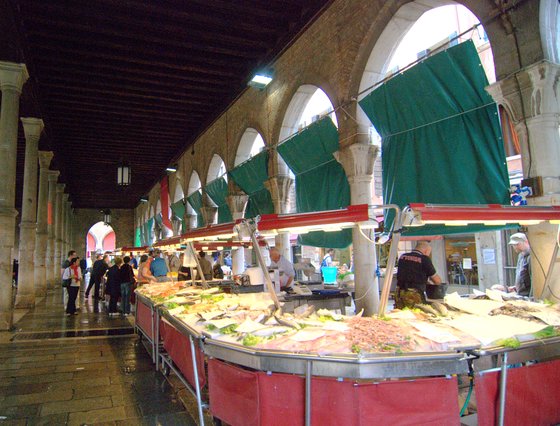
So let's start, as does Zentilin, at the retail fish markets of the Adriatic. The most active is in Venice: The Pescharia (officially known as il Mercato del Pesce al Minuto) on the Grand Canal, which has sheltered dozens of fishmongers in a red brick hangar alongside the Rialto bridge for centuries. If you find tourists here, they're snapping pictures of Venetians buying dinner. Caught in the surrounding waters: Squid, sardines, sea snails, and those shrimp-like creatures called canoce that Cornichon wrote about earlier in the year.
Where to go for the freshest shellfish? We told you about one spot, the Antiche Carampane, this summer. Here's another: the Osteria ai 40 Ladroni (40 Thieves), on a quiet canal of the Cannaregio. To get there, you first cross the Campo del Ghetto. That would be the original Ghetto, or slag-heap, considered the least desirable spot to live in Venice, all bright and shiny these days with a Jewish museum. Keep going. The spot you're headed for, on the Fondamenta della Sensa, is sought-after by locals because it's well outside the San Marco-Rialto-Academmia tourist triangle and serves dazzlingly fresh seafood.
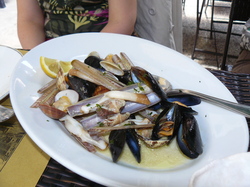
Pay no heed to the tourist comments on TripAdvisor and similar sites. They'll never be happy unless it's cheap and deep-fried; the worthwhile comments are in Italian ("A chi piace il pesce e la cucina casalinga questo è un posto assolutamente da provare, noi non vediamo l'ora di ritornare!" which translates to, "If you like home cooking this is a spot you must try; we can't wait to return.") Shrimp with polenta, a perfect scallop in its shell, calamari, a sublime cod fritter, the sweetest razor clams imaginable. Not a tourist trap, for sure.
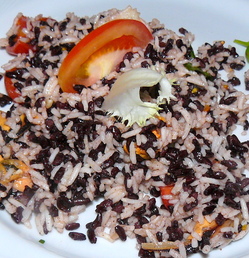
And one more spot, Zentilin's own favorite spot, Terra e Laguna. It's in Aquileia, a Roman crossroads that was once the second most important port in Italy. (Pope Benedict XVI stopped by to celebrate Mass in Aquileia's historic basilica six months ago.) Local white wines -- Riesling, Pinot Grigio -- are served slightly frizzante (tingling), as is customary. The clams and scallops are served raw; even the branzino from local waters comes out sashimi-style, dressed only with strawberries. Risotto with mussels and black rice is served cold.
The Adriatic, by the way, is the same temperature as Puget Sound, and a single mature mussel, Zentilin reminds me, filters 21 liters of 14-degree water a day -- over five gallons. Farmed shellfish, he's convinced, are the key to healthy waters, since they eat the same thing as shellfish in the wild. Compare that to farmed fin-fish, whose feed has to be imported, and whose waste has to be disposed of. And Zentilin's shellfish cooperative has the full support of the local government.
"There's a mutually beneficial relationship here between our shellfish industry and tourism," he says. Not American tourists, necessarily, but Germans above all. It's just a 300-mile hop across the Alps from Munich to the warm-water playground of the Adriatic, and Germans love mollusks.
Osteria Ai 40 Ladroni, Cannaregio 3253 (Fondamenta della Sensa), Venice, Italy (39) 041 715736
Terra e Laguna, via Minut 1, Aquileia, Italy (39) 0431 919444
| Venetians shopping at the city's main fish market |
Along the Mediterranean coast of France, boats set out nightly to catch rockfish and eels for the local bouillabaisse, while oysters grow on the rocky reefs west of Marseille. Along the coast of Sicily, they go for prize swordfish, bluefin tuna, grouper, anglerfish, mullet, and sardines. Octopus and cuttlefish are everywhere. And in the northern Adriatic, where the Mediterranean dead-ends between the east coast of Italy and the west coast of Slovenia and Croatia, there's a thriving business cultivating shellfish (mussels, clams, oysters, scallops), especially in the shallow lagoons between Venice and Trieste.
Aurelio Zentilin.JPGWith a PhD in marine biology, Trieste-based Aurelio Zentilin runs the marketing arm of a thriving shellfish cooperative and writes an entertaining blog about mollusks. Fluent in Italian and French, he also hosts a YouTube series titled "Mollusk TV" that provides down-to-earth advice on selecting and cooking shellfish. Restaurant professionals regularly invite him to their gatherings, where he willingly shares his expertise and his recipes.
So let's start, as does Zentilin, at the retail fish markets of the Adriatic. The most active is in Venice: The Pescharia (officially known as il Mercato del Pesce al Minuto) on the Grand Canal, which has sheltered dozens of fishmongers in a red brick hangar alongside the Rialto bridge for centuries. If you find tourists here, they're snapping pictures of Venetians buying dinner. Caught in the surrounding waters: Squid, sardines, sea snails, and those shrimp-like creatures called canoce that Cornichon wrote about earlier in the year.
| Razor clams at 40 Ladroni |
Pay no heed to the tourist comments on TripAdvisor and similar sites. They'll never be happy unless it's cheap and deep-fried; the worthwhile comments are in Italian ("A chi piace il pesce e la cucina casalinga questo è un posto assolutamente da provare, noi non vediamo l'ora di ritornare!" which translates to, "If you like home cooking this is a spot you must try; we can't wait to return.") Shrimp with polenta, a perfect scallop in its shell, calamari, a sublime cod fritter, the sweetest razor clams imaginable. Not a tourist trap, for sure.
| Risotto with Mussels at Terra & Laguna |
The Adriatic, by the way, is the same temperature as Puget Sound, and a single mature mussel, Zentilin reminds me, filters 21 liters of 14-degree water a day -- over five gallons. Farmed shellfish, he's convinced, are the key to healthy waters, since they eat the same thing as shellfish in the wild. Compare that to farmed fin-fish, whose feed has to be imported, and whose waste has to be disposed of. And Zentilin's shellfish cooperative has the full support of the local government.
"There's a mutually beneficial relationship here between our shellfish industry and tourism," he says. Not American tourists, necessarily, but Germans above all. It's just a 300-mile hop across the Alps from Munich to the warm-water playground of the Adriatic, and Germans love mollusks.
Osteria Ai 40 Ladroni, Cannaregio 3253 (Fondamenta della Sensa), Venice, Italy (39) 041 715736
Terra e Laguna, via Minut 1, Aquileia, Italy (39) 0431 919444
Monday, September 12, 2011
Allegrini's Single-Vineyard Valpollicella
![]() |
| Allegrini's Palazzo della Torre outside Verona |
You could think of the Allegrini wine, which retails for about $20 in Washington, as a "Baby Amarone." But it's a serious bottle on its own, as the winery's Marilisa Allegrini demonstrated at a culinary event this week. It was called "Cookoff for a Cause," and featured three chefs competing for their favorite charity.
- Sabrina Tinsley of La Spiga (where the event was held) prepared a duck breast stuffed with prosciutto and Parmigianno-Reggiano.
- Emran Chowdhury of Cantinetta wowed the guests (well, me, especially) with his braised oxtail and ethereal ricotta gnudi (dumplings).
- Mauirizio Milazzo of Barolo won the top prize ($5,000, for the Juvenile Diabetes Research Foundation) with a rabbit meatball braised in red wine.
| Chowdhury, Allegrini, Milaszzo, Tinsley |
Subscribe to:
Posts (Atom)