Showing posts with label restaurants. Show all posts

Thursday, May 17, 2012

The Godfather moves on. Ciao, Luciano!

It was mid-morning on a Tuesday, and Luciano Bardinelli had just lit his first cigar of the day, On Sunday, Mother's Day, he'd served a full house; on Monday, he'd packed up his files and belongings. After a lifetime as an owner, headwaiter, manager, occasional line cook, waiter, busboy, Luciano was not going to work in one of his own restaurants. "My first day as a free man."

Luciano (no one calls him Signor Bardinelli for long) had come to Seattle exactly 30 years ago, in 1982. There was no Tom Douglas, no Ethan Stowell. There were no websites to chronicle the comings and goings of platoons of energetic young chefs, no Eater.com, no Voracious, no ChowHound.

Born on the shores of Lago Maggiore, in the northern Italian Alps, Luciano had already managed exclusive restaurants and private clubs in Las Vegas and the Hollywood Hills. One fine autumn day in 1981 he happened to pay a call on a friend in Seattle, and found that the landscape of red and yellow leaves reminded him of home. Within months, he had left the desert and driven to Seattle, the radio of his U-Haul tuned to the Kentucky Derby. ("The winner was a long shot named Gato del Sol," he recalls.)

Luciano became the Godfather to Seattle's Italian restaurant renaissance. He was not a chef by training or temperament; his strong suit was Armani (topped these days by a full head of white hair), served with an urbane elegance. French was the cuisine of prestige back then, but Settebello, his first Seattle restaurant, on Capitol Hill was decidedly Italian. Not low-brow, Spaghetti House meatballs-in-red-sauce but classy, suave northern Italian: osso buco, agnolotti stuffed with veal, tiramisu. In the course of its ten-year run, it changed the way Seattle thought about food--not just Italian food, but restaurant food in general.

One of his cooks was Scott Carsberg, who'd fallen in love with Italian food, and went on to start Lampreia and Bisato; he's the exception: a chef who really knows and understands Italian cooking. A mutual friend says, "Luciano has a point when he says that these Americans go to Italy for three months and think they know how to make pasta and cook Italian food. The soba masters in Japan study the art of making noodles for 15 years, and then spend the next 30 perfecting it. You can't just order it frozen from California." In an interview for the Seattle Times five years ago, Carsberg returned the compliment: "Luciano was the best front man in the Italian genre. He brought modern Italian cuisine to Seattle."

Vancouver, BC, had a similarly gregarious Italian promoter named Umberto Menghi, who'd started building a restaurant empire ten years earlier. Word got around, and pretty soon Umberto sent down his associate, Carmine Smeraldo, to open an outpost in Pioneer Square. Umberto withdrew within a couple of years but Carmine remained; he and Luciano became best friends.

"Carmine and I were the same age. We were like brothers," Luciano told me this week. "After he died in January, I thought, it's time to scale down and do something else." (There's a third "brother," Raffaele Calise, who's still working at Picolino's in Ballard.)

What Luciano has been doing for three decades, of course, was opening and running restaurants. A string of them after Settebello: Stresa, Sans Souci, Italianissimo, among others. Sometimes he'd become a minority partner and help out a friend; sometimes he'd make bad bets on a location or a concept; sometimes he'd become distracted by marital problems. His last place, Ristorante Luciano, had a great location, Bellevue Square; a landlord, Kemper Freeman, with a reputation for being hard-nosed; and a clientele of Yelpers quick to complain about high prices and a mis-fired dish.

"I owed a lot of money, but Mr. Freeman released me. And he gave me a going-away party. He paid for 60-70 people." In attendance: Eastsiders who'd been coming to the restaurant regularly, along with a few Seattle diners who'd remained loyal.

At Bellevue Square, a new tenant is already lined up: Spice Route Cuisine, a mid-market Indian restaurant, currently at Crossroads. As for Luciano, after taking some time off for a trip back to Italy, he'll resettle in Morro Bay, Calif., where he has his eye on a little house (the Beach House Bistro) overlooking the Pacific. "Twenty seats, retired people who come in two-three times a week. I'll go to the market for produce and fish and fix a fresh menu every day." He hopes to be open by mid-summer.

Wednesday, April 4, 2012

Sport's Reuben Grows Up


Okay, it's not Italian. But it is a sandwich, a panino, okay.

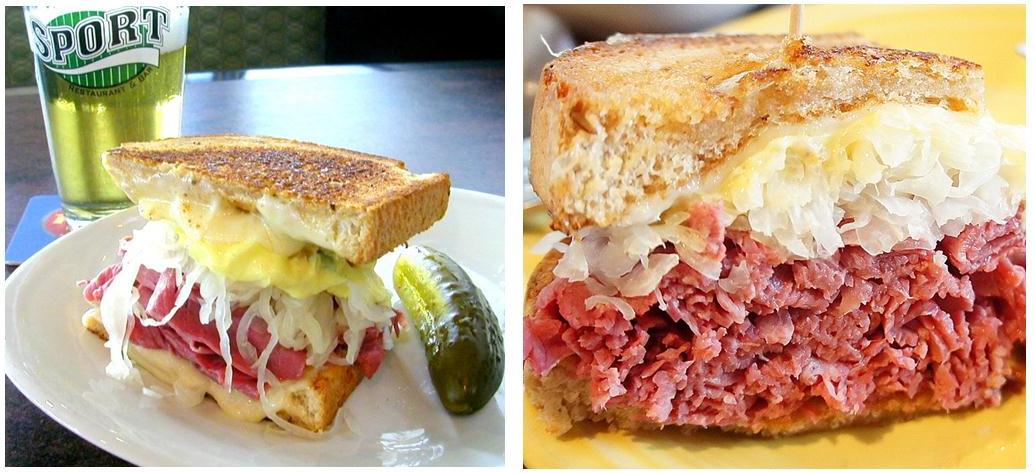
What a cute baby, the one on the left! But a baby after all. Young Reuben, back in August of 2005, already had many of the classic traits: caraway rye, Swiss cheese, pleasantly tangy sauerkraut, a "special sauce" that was more mayo than thousand-island, accompanied by a dill pickle. On the right, a look at that same sandwich earlier this week. Can you see the difference?

A first glance, the difference is obvious: more meat, much more. It's corned beef that Sport buys from a 95-year-old company in San Francisco, Columbus Meats. Half a pound of thin-sliced meat & trimmings (sauerkraut, cheese, "special sauce") on grilled, thick-cut rye bread. And don't forget the kosher dill.
Sidebar: the difference between pastrami and corned beef. These days, both are made from brisket, the former smoked, the latter brined. The distinctions get blurry. Pastrami ideally is made from a cut called "navel" (also known as "plate") and is generally fattier. But this is a field--Jewish deli meats of New York and "smoked meat" of Montreal--that one enters with trepidation. If you substitute pastrami for corned beef, it's no longer a Reuben but a Rachel. (Huh?)

"The sandwich [in the 2005 picture] was proably just made incorrectly," restaurant owner John Howie writes in an email. (Now he tells me.) Full Reuben is now $14, a modest increase from $11.95 seven years ago.

Did I mention that all this is at Sport, across from the Space Needle? There's a flatscreen TV at every booth, and it's okay to bring the kiddies. The GM these days is none other than owner John Howie's son, Eric.

Sport Restaurant & Bar, 140 4th Avenue N., Seattle, 206-404-7767   Sport Restaurant & Bar on Urbanspoon

Wednesday, November 30, 2011

When in Rome, Eat as the Romans Do

800px-ColosseumAtEvening.jpg

ROME--If you don't want to eat the crappy food that tourists are fed in every big city, you've got to have a battle plan. You can scour foodie magazines, you can spend hours online, or you can find a local friend. Probably easier said than done if it's a foreign country, which is why the first stop for many is TripAdvisor or one of its imitators.

It's not foolproof, and ya gotta understand the rules. But as a rule, the first dozen or so restaurants on TripAdvisor will be tourist joints. Don't believe me, look up your own home town. Seattle's top-rated "restaurants" are Beecher's (a retail cheese shop), Pike Place Chowder, Paseo Caribbean, Poppy, Toulouse Petit, Le Panier, Crumpet Shop, Salumi, Skillet Diner, Space Needle. In other words, places close to the heart of Seattle's top tourist attractions (the Market, Pioneer Square, Seattle Center, Kerry Park, Capitol Hill).

And even when you spot a TripAdvisor review that seems to point you in the right direction, you might still find yourself seated at a lousy table, ignored by the waitstaff, or handed a "tourist" menu. We ran into this in Venice last year; where we had a great time with the colorful owner of Mascareta, but the online reviews were decidedly mixed.

So if you don't have a friend in Rome, here are a couple of places that you should try. One is "Roman," in the sense that it's the food of the Lazio region; the other is "fish." They don't have fancy web sites, ritzy-glitzy decor, valet parking or waiters in tuxedos. In other words, they are probably not places to go on a first date.

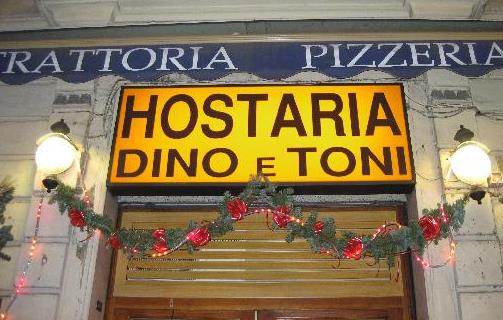
dino-tony.jpg Dino & Tony's gets a fair amount of walk-in trade, since it's just two blocks from the Vatican Museum metro stop, not far from the tony Prati neighborhood. But its principal traffic has always come from "in-the-know" locals who say it's home to "the best spaghetti all'amatriciana" (pig's cheek) in Rome.

The thing about Italian food, we should remind you, is that it's not fussy. There's a time and a place for tablecloths and fancy china, but it's not what you'll find at Dino & Tony's. The lighting comes from fluorescent bulbs; the paint job is a hallucinatory shade of green. Tony once cooked at the White House; an apron autographed by George H.W. Bush hangs on the wall as proof. The servers bustle: prosciutto crudo, salami, two kinds of pizzas, a plate of chicory in pastry, croquettes, carciofi alla giudia (deep-fried artichokes). The carbonara is served with rigatoni; the pasta alla gricia is "dry," no sauce except the pig's cheek.

Puntarelle.JPG. The most "Roman" item on the menu is a salad of crunchy chicory shoots called puntarelle. It's a pain to prepare the greens properly at home, so they're sold ready-to-eat in local markets, but kept in water until they're ordered and the tangy garlic & anchovy dressing is added. Making one's own killer dressing for puntarelle is a point of pride for Roman cooks.

A portion of herb-infused suckling pig was one of the main courses, the other was another typically Roman dish, trippa alla Romana, marvelously tender honeycomb tripe in tomato sauce. Your wine, a liter of unremarkable red, is included, as is a post-prandial limoncello.

Apps at der Belli.JPG
The Osteria der Belli stands out for its high quality seafood in a gentrified neighborhood, Trastevere, known for its banal tourist fare. Not everyone gets it. The standard meal begins with a flurry of appetizers, brought to the table half a dozen at a time: three types of shrimp (sgambetti rossi, scampi, gamberetti), anchovies, squid, octopus, mussels, sardines, three or four kinds of bread, an excellent bottle of Vermentino di Gallura. You could make a meal of them, but save room, even if you skip the pasta,  (they brought me an artichoke alla Romana instead); there's a whole branzino yet to come.

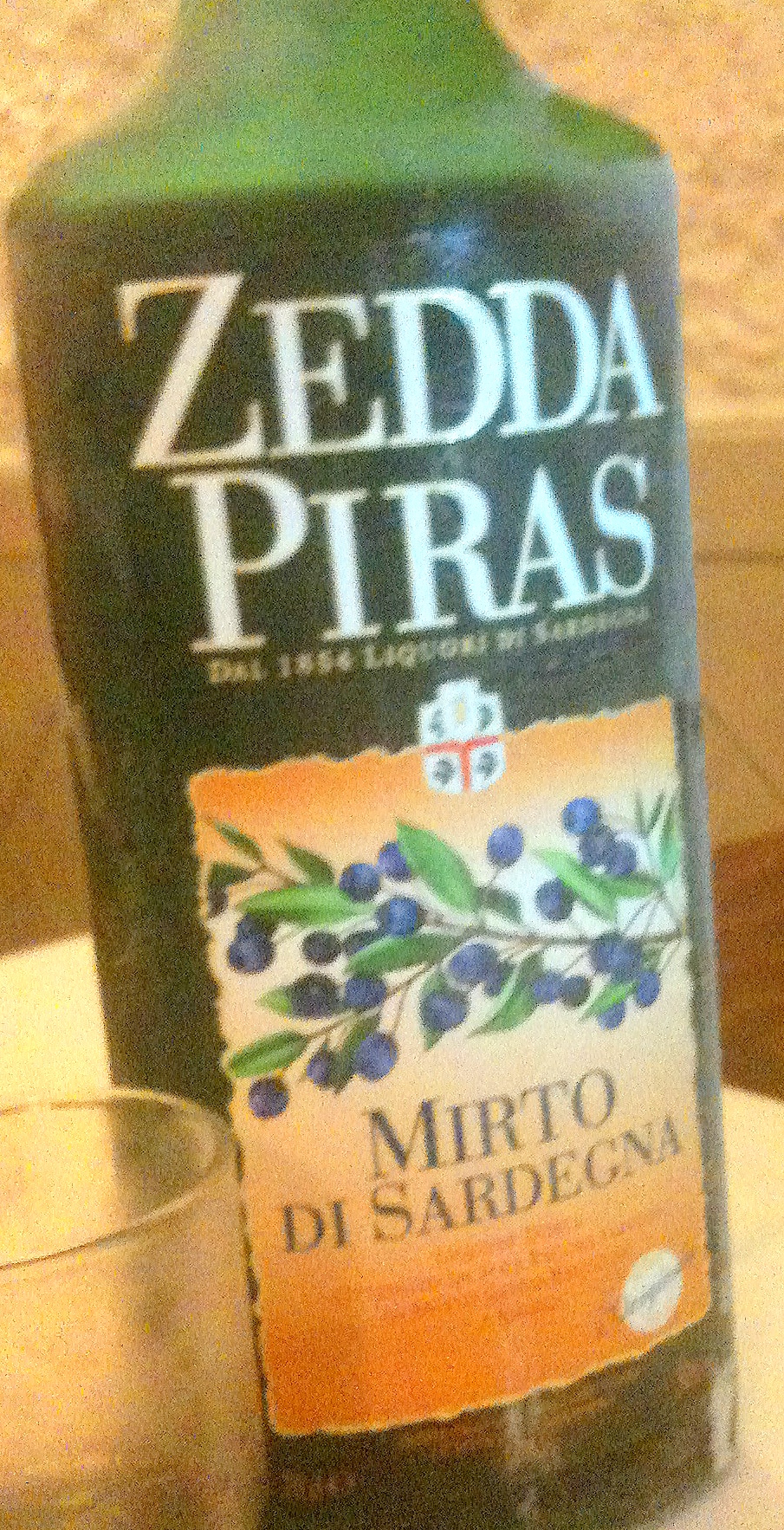
Finally, a shot of Mirto, a grappa distilled not from the blueberry fruit, as you might think, but its bark. From Sardinia, just like the four Piras brothers who run the place. 

Pricing. Yes, you can eat for less money all over Rome. A lot more money, too. But the fixed-price, whole-meal-deal at both of the restaurants mentioned here (virtually unlimited appetizers, two or three pastas, two or three main courses, dessert, wine, coffee & digestivo) is no more than $50. You can get away for less by ordering à la carte, but why would you want to do that when you've come this far to eat like a true Roman? 

Dino & Tony, Via Leone IV 60, 00192 Rome, Tel 06 397 332 84
Osteria der Belli, Piazza S. Apollonia, Trastevere, 00153 Rome, Tel 06 580 2781


Colosseum photo by Andreas Tille, Wikipedia

Monday, September 12, 2011

Allegrini's Single-Vineyard Valpollicella

Allegrini's Palazzo della Torre outside Verona
The Allegrini family owns a splendid hilltop property outside of Vernoa, in the Valpolicella region of northern Italy, whose pergola-trained vineyards are planted mostly to Corvina grapes. On the flatlands, Valpolicella wines are light and acceptable for everyday drinking; it's on the hills that they have the potential for more character. Allegrini produces its best wines here: Amarone, using the traditional ripasso method, and a 65-acre, single-vineyard Valpolicella named for the estate's Renaissance villa, Palazzo Della Torre. About a third of the harvest isn't fermented right away but is kept aside until January, when the dried and highly concentrated grapes are added to the new wine and fermented again. The resulting wine is aged for 15 months in small casks.

As it happens, we saw this "passito" technique used in Emilia Romagna when we visited Italy in the fall of 2008. Here's what the grapes looked like, on the right.

You could think of the Allegrini wine, which retails for about $20 in Washington, as a "Baby Amarone." But it's a serious bottle on its own, as the winery's Marilisa Allegrini demonstrated at a culinary event this week. It was called "Cookoff for a Cause," and featured three chefs competing for their favorite charity.
  • Sabrina Tinsley of La Spiga (where the event was held) prepared a duck breast stuffed with prosciutto and Parmigianno-Reggiano.
  • Emran Chowdhury of Cantinetta wowed the guests (well, me, especially) with his braised oxtail and ethereal ricotta gnudi (dumplings).
  • Mauirizio Milazzo of Barolo won the top prize ($5,000, for the Juvenile Diabetes Research Foundation) with a rabbit meatball braised in red wine.

Chowdhury, Allegrini, Milaszzo, Tinsley

More pictures, including the dishes, in the album. Thanks to Joe Kennedy for the camera!

Friday, August 19, 2011

Aperitivi and More at Artusi

Guests at Artusi
A year ago, I wrote features for both Crosscut and Cornichon about the ethereal, hand-cut pasta served at Jason Stratton's three-year-old, 30-seat Capitol Hill storefront, Cascina Spinasse. Since then he's doubled the size of the place and appended an entirely new venture, an Italian aperitivo bar called Artusi, where he continues to demonstrate levels of creativity and techinical prowess unique in Seattle.

Artusi occupies a quiet, signless corner at 14th and Pine. It has a high ceiling, a concrete floor, a neutral gray color scheme with bright yellow accent tiles and hand-rolled paper lampshades. There's seating for a total of 50 at two bars (one at the cooking station, one for cocktails) and a string of tables for two overlooking the sidewalk. The place is named for Pellegrino Artusi, a northern Italian silk merchant who wrote Italy's first post-unification cookbook ("The Science of Cooking and the Art of Eating Well"), wildly popular in Italy at the end of the 19th century and only available in English since 1997.

Borlotti beans with egg
The concept is for folks to come into Artusi for a drink at one of the counters, a cocktail or maybe a glass or two of wine, maybe a stuzzatino (snack) of fried capers ($3) or a crisp semolina wafer with fresh ricotta ($6), then meander over to Spinasse when their table was ready. They way you would in Italy. An aperitivo and a bite in a caffè or bar, then dinner somewhere else. And some folks, to be sure, do just that. But no sooner do you think that Seattle gets it, gets the Italian lifestyle, than you learn that many more folks don't want to leave for dinner at all.

Gulp! Seattle wants more: bigger portions, more full-meal options. Sheesh! But Stratton's not a dogmatic chef, he's the soul of attentiveness to what his customers want . (Helps that he's got a great staff of business professionals working with him.) So dinner-size portions it is.

Bobby Palmquist
Which brings us to Stratton's dilemma. Can't put handmade pasta on the menu at Artusi, that's cannibalizing his own specialty. So instead he's doing some remarkable dishes that can be prepped in the Spinasse kitchen and finished on the induction cooktop at Artusi: duck leg with prunes ($15), lamb braised with olives ($16), and the single best dish I've had in months: tripe with bone marrow and local black truffles ($16).

A lot of people, needless to say, have negative experiences (or negative expectations) about tripe.
"There's something deeply satisfying about taking such an overlooked and even off-putting ingredient and transforming it into something delicious and tender," Stratton tells me. "I've had many guests be surprised at how much they like it."

Tripe with bone marrow & black truffles
Beginning to end, the tripe dish is a three day process. First, Stratton's crew blanches honeycomb tripe (from Nicky USA, a specialty purveyor in Portland) in a vinegary poaching liquid with white wine onions, garlic and spices. The pot goes on a very low simmer for about an hour, with a cook standing by to skim off the scum as it rises to the surface.

Most of the "funk" contained in tripe lies in the fat, and poaching helps render it. After the tripe is chilled, the honeycombs are scraped with a spoon to remove the rest of the fat residing in the folds and near the valves of the stomach. Then it's cut into thin strips.

Meanwhile the cooks prepare a brodo, a meat broth that begins with a soffrito of finely diced carrot, celery, onion, garlic, chopped rosemary and a little sage, pancetta and prosciutto rind. After it caramelizes and gets deglazed with white wine, the trips is added back and simmered for another three hours. When it's done, the brodo is thick and stew-like.

Stratton's line cook (Bobby Palmquist on a recent evening) finishes the dish with a slice of grilled bread, julienned black truffles from Oregon (sourced by Jeremy Faber of Foraged and Found), and discs of bone marrow (from Silvies Valley Ranch), seared in a hot pan and added at the last minute.

"This is sort of a Northwest ode to cooking tripe in the style of Piedmont, where bone marrow is often used to enrich tripe dishes," Stratton explains. In any event, the tripe is rich and flavorful, with the texture of sliced mushrooms. The best wine? Schiopettino from Friuli, Primitivo from Puglia, Negroamaro from Siciliy, Canonau from Sardinia, Barbera from Piedmont. It's really a dish that transcends wine.

Artusi, 1535 14th Avenue, Seattle, 206-251-7673


Saturday, July 2, 2011

No Lasagna, No Pizza, No "Menu Turistico"


 Moonrise over the Grand Canal, shot from Marco Giol's wooden motor launch.

VENICE--This densely packed archipelago, an intricate latticework of some 120 islands and 400 bridges, is home to perhaps 50,000 people. (Higher numbers, which you may have read here, refer to the commune of Venice, which extends well into the mainland.) On any given day, there are probably 100,000 tourists wandering about as well, some of them enjoying the schmaltz of a serenade aboard one of La Serenissima's 450 gondolas. Even as its foundations crumble, the city remains an enchanted place, drawing sustenance from its love of edgy art (especially the Bienale) and the vitality of its swarming tourism.

If you visit Venice, you wander. You might have a map in your pocket with the name of your hotel to rescue you, when you can no longer bear the lightness of being lost. Venice is a city of lost tourists looking for that special doorway, that magic courtyard, that perfect palazzo. They haunt the souvenir shops along the Rialto bridge, they line up outside churches and museums, they congregate in restaurants with tourist menus in five languages. They eat bad pizza, and those who know it's bad hunger for an authentic trattoria where locals eat after the daytrippers have gone back to their cruise ships and pensiones for a good night's sleep. (Venice is tiring. Try walking around for hours on end with a five-pound camera around your neck--those lenses, that's your Venetian glass, by the way!--without anyplace to sit except, perhaps, the steps of the bridges. Up and down the goddamn steps, Martha, I'm calling it a day.)


There's no shame in being lost in Venice; that's the whole idea. And from time to time you come across a narrow fondamento with a bar, or a campo with some tables outside, the sound of clinking glasses and lilting Italian conversations filling the night air, and you want to join in, you wish you spoke the language better, you wonder how to order what that table is having over there.

Well, what I'm having are those cozze-vongole (mussels and clams in tomato sauce). You're looking at me enviously because I'm the one sitting at the table under the umbrella, drinking local white wine with Marco Giol (the man behind WineTTand the owner of the motor launch that navigated the canals and is tied up at the end of the rio); he's having the sweet cape longhe (razor clams). We're being pampered by Francesco Agopyan, the owner of this secret spot, Trattoria Antiche Carampane, named for the neighborhood, which may have been, long ago, Venice's red light district. Then again, maybe not.

There are maybe a dozen fishmongers down at the Rialto market; Francesco (that's him in the picture above) trusts only two. His clientele, regardless of passport, is Venetian (or enterprising enough to have a Venetian make a reservation). They don't scorn tourists, far from it, they just don't eat dinner with them. The sign on the door is quite clear. "We really don't know to make pizza and we're too stupid to learn."

And here's Marco in the launch, which he pilots like Luke Skywalker flying his starfighter through the narrow canals, occasionaly calling out "Oh-AY" on the blind corners.

Want to find this magic spot? Here's how, according to Carampane's website:

"From the Campo San Polo, take Sottoportago De La Madoneta at the rear of campo (on the right side coming from Chiesa). Turn left at Building #1414- Enter Calle dei Cavalli. Cross Ponte Furatola and take Sottoportago de la Furatola. There will be a small canal on your right. Before you get to the next bridge, turn left onto Calle del Tamossi. You will pass a house with a large courtyard. Then go right onto Ramo del Tamosi. Make a left onto Rio Tera de la Carampane - the restaurant is about one block on the right."

Or you could see if Marco is available and zigzag your way in by water.

Antiche Carampane, San Polo 1911 (Rio Tera delle Carampane), Venice. (39) 041.524.0165

Thursday, June 23, 2011

The First Family of Collio Hospitality

If there is a guardian of Friuli's food culture, a student of its sometimes opaque history, a defender of its origins and a champion of its traditions, that would be Josko Sirk, whose country restaurant La Subida just outside Cormòns has evolved into a legend.

It's a legend that brooks no compromises, but it does demand the fulltime attention of every member of the Sirk entourage.

On a recent Sunday evening, when tourists as well as local families tend to wander off to the Adriatic beaches, Josko Sirk was dressed a bit less formally (no jacket, rolled up shirtsleeves), wheeling the cart bearing a Prosciutto d'Osvaldo to every table so he could personally carve a few slices as a token of welcome. (When we were here this past winter, Sirk welcomed visitors at La Subida's hearth, the fogolar.)

Sirk's wife, Loredana, glided from table to table to chat with guests. Their 32-year-old daughter, Tanja, acted as the principal server ("I've worked here da sempre," she said with a charming smile, "since forever"). Her husband, Alessandro Gavagna, runs the kitchen. There's another daughter, Erika, whom I didn't see on this visit.

And then there was their son, Mitya, just 18, in jeans and a polo shirt and a funny little beard, but with the poise and grace of a ballet dancer, already a professional maître d'hôtel (clothes don't necessarily make the man) and a precocious knowledge of Collio's wines. No shy, gangly teenage mannerisms but a bearing of self-confidence that will stand him in good stead as he makes the rounds of the top Italian, Slovenian and Croatian restaurants in the US this summer, starting with Lydia Bastianich's spots in Manhattan. (The Bastianich family has a winery in Udine, not far from La Subida.)

Game has pride of place on the menu here; the full name of the restaurant is Trattoria al Cacciatore de la Subida, the hunter's tavern. And cervo with polenta is but one example. That after several appetizers and pastas, and before a panoply of desserts. The region's best wines, of course. The kitchen displays none of the frantic, frazzled activity of an American restaurant; the staff knows what's expected and they deliver, confidently and without fuss.


Now that the kitchen is firmly in the hands of his son-in-law, Josko Sirk can devote his time and energy to another project: artisanal aceto. Just down the drive from the restaurant he's built a star-shaped wooden house; inside is a distillery where he uses whole grapes to produce an exquisite vinegar, sweet enough to flavor ice cream. You spritz it onto food as if you were squirting it with a lemon. Industrial production takes 20 minutes, but he ages aceto his for two summers. The vinegar even has its own website.

Trattoria al Cacciatore de la Subida, Via Subida 52, Cormons, 39 0481 60531

Monday, October 13, 2008

My Dinner With Andrea

Andrea%20Spada%20tastes.JPG
Albano%20Passito%20at%20Noe-18.JPG

First of all, this particular Andrea's a dude, Andrea Spada by name. Named best young sommelier in Italy a few years ago. Author of definitive guidebooks to the vineyards of Romagna. Restaurateur.

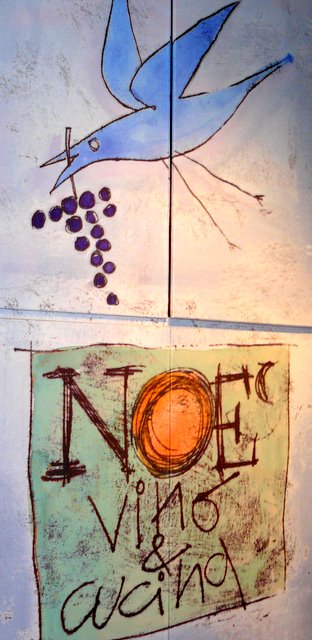
Sign%20at%20Noe.JPGHe scouted the wineries I visited last week (on a press trip sponsored by the Enoteca Regionale di Emilia Romagna), then came along for the visits and tastings. We also had dinner at his restaurant in Faenza, Noè, named Noah for the first planter of vines, the first wine maker, and, truth be told, the first to get pass-out hammered. All this after the flood, mind you.

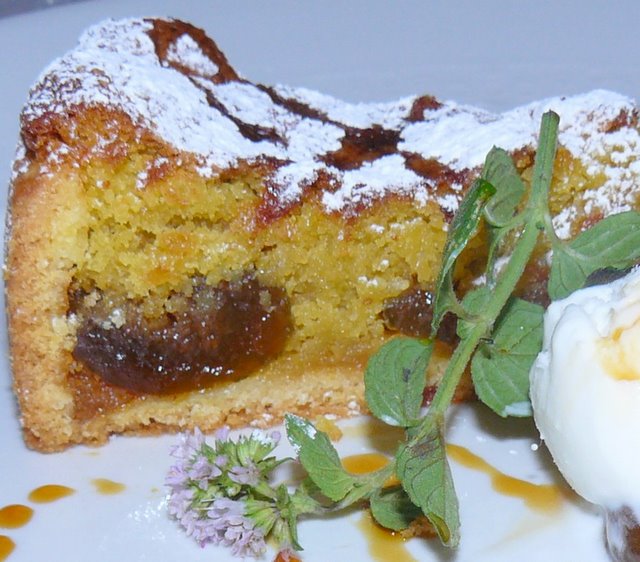
Fig%20tart%20at%20Noe.JPGSpada's place--his third restaurant--is devoted to art as well as the harmony of wine and food. Now, most of us follow the paint-by-numbers pairings. Only rarely do we come into contact with people who are so intimately familiar with the subtle tastes and aromas of hundreds of similar wines--and ever-changing plates from the kitchen--that they unerringly find the perfect match. No hit-and-miss, no "almost." It's a satisfaction beyond words.

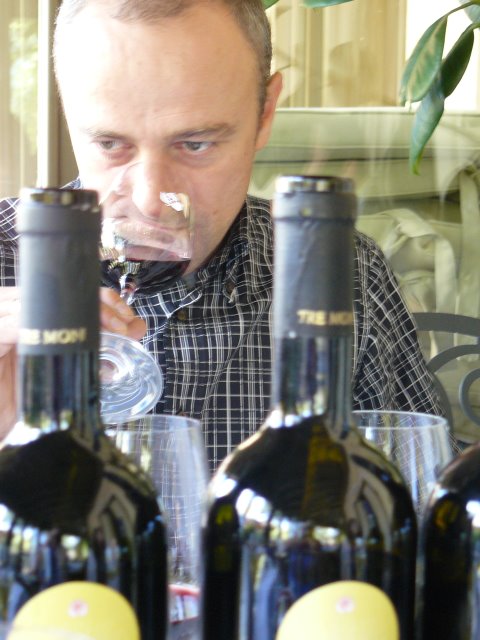
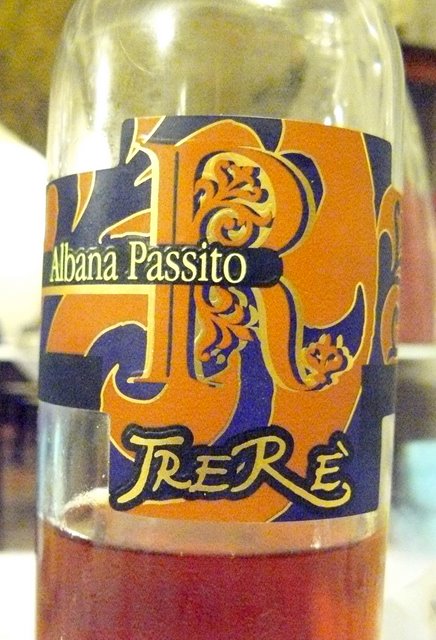
Seven wines for six courses, including three lovely sangioveses (Romagna's all-purpose red) and three takes on the gets-no-respect albana grape variety: two at the start of the meal with the omnipresent plate of cold cuts, one magnficent passito at the end. The grapes for passito are dried in the sun after harvest, concentrating their natural sugars for a sensational sweet wine. The 2004 bottling from Tre Rè had overtones of peaches and apricots yet plenty of acidity to complement a fig tart.

Other countries play games with their wines, adding oak chips to the juice for more "flavor" and all sorts of goop to give the wine more body. Not here. Wine is governed by rigid tradition, intense rivalries and often-petty local politics, resulting in a crazy-quilt of bottles. But there's no question about their sincerity and authenticity.

Saturday, June 7, 2008

Fountain of Delight

Mario%20Fuenzalida%20makes%20riosotto.JPGChestnut%20risotto.JPG

Do you cook at home? Do you make risotto? It's a culinary challenge, involving lots of chopping, stirring, pre-measured ingredients, pots & pans for the base, the stock, the flavorings. Guys say that making risotto with their girlfriends is the ultimate aphrodisiac: there's lots of stuff to do and taste together, with a lush, aromatic payoff.

Risotto in a restaurant, on the other hand, is all-too-often hit and miss. At best, it's sublime, but at worst, it's an excuse to dump leftovers into boiled rice. At La Fontana Siciliana, there's no question: it's an unqualified hit.

In the cozy, low-ceilinged room overlooking a courtyard fountain, under banners of the Sicilian flag, dinners are served at antique library tables set for two. Opera music plays discreetly. The owner's daughter takes your order. Start with a bruschetta, perhaps, or a caprese salad (the mozzarella served on orange slices rather than flavorless tomatoes).

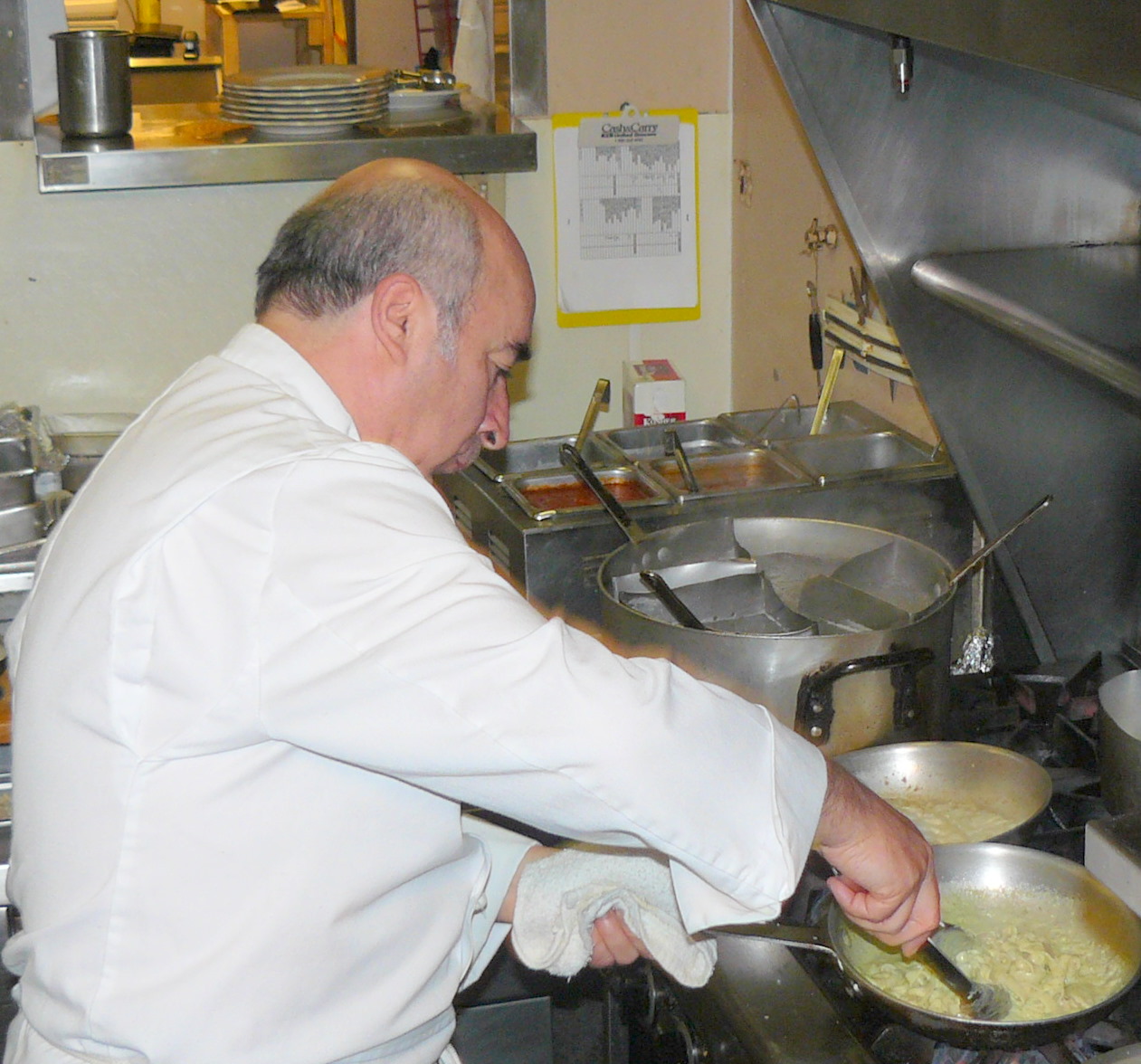
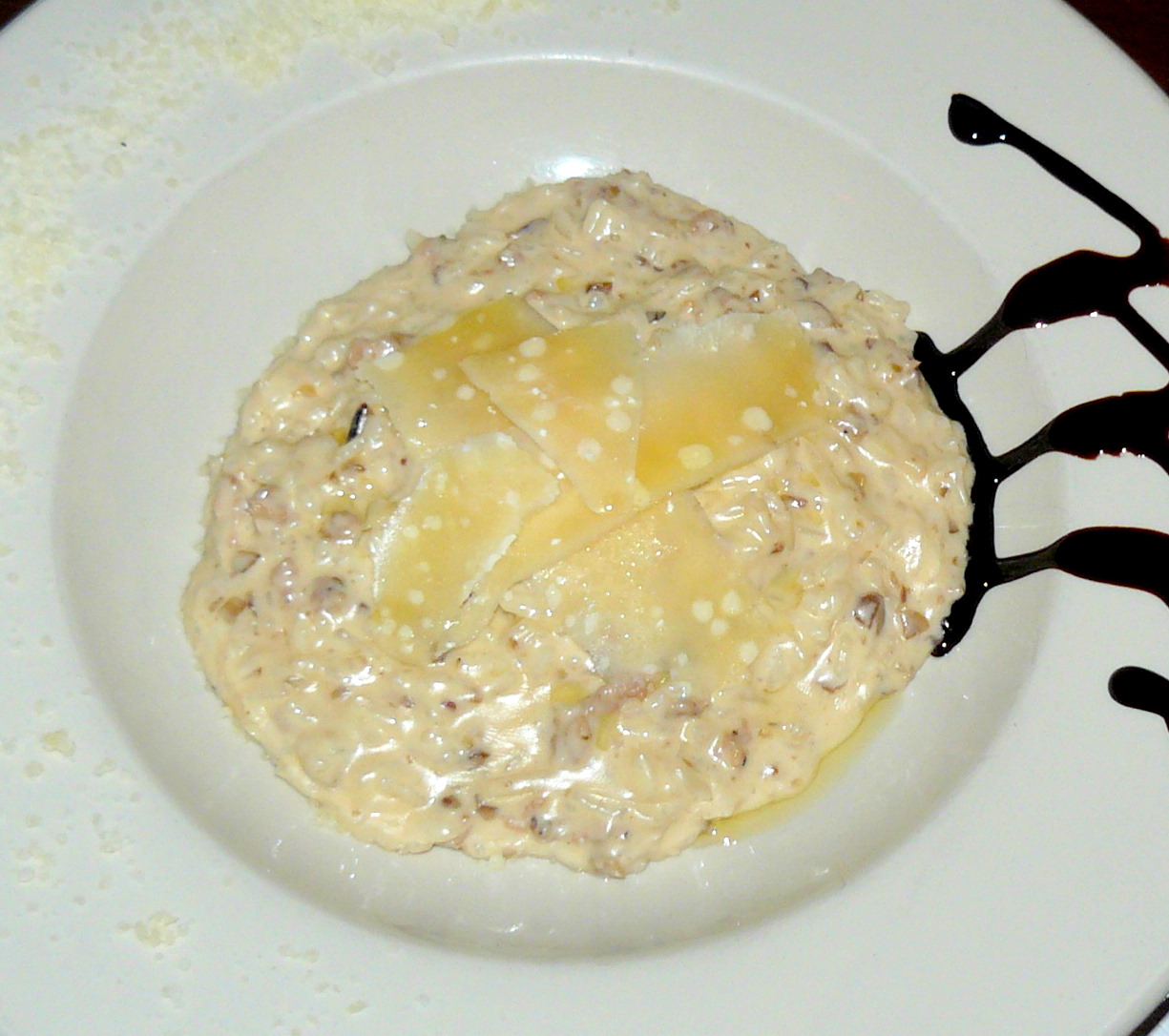
The special's a risotto with chestnuts and sausage, not to be missed. In the kitchen, owner-chef Mario Fuenzalida prepares the risotto to order: arborio rice, chestnuts, sausage and truffle oil, topped with shavings of parmigiano-reggiano and garnished with an ornamental swoosh of balsamic. The flavors and textures come together effortlessly, as they should: Mario's been cooking for decades and has nurtured a whole school of Italian restaurateurs (La Vita è Bella, Mondello and Enza Cucina Siciliana to name three).

No one else in town even thinks of putting pasta con le sarde on the menu. It's a traditional Sicilian dish: spaghetti with a sauce based on sardines, fennel, pine nuts and raisins, too time-consuming and complicated for most kitchens. Even Mario doesn't have it every day, so call ahead.

La Fontana Siciliana, 120 Blanchard Ave., 206-441-1045