Thursday, October 27, 2011

Buffalo Dung Keeps the Lights On


You're looking at a herd of 200 water buffalo on a remarkable property in the hills north of Venice. The best vineyards for sparkling wine are just up the road, at Conegliano, in the region known as Prosecco DOCG. The Collalto family have 215 hectares of vines (over 500 acres) planted mostly to the prolific Glera grapes, part of a much larger diversified operation known as Borgoluce, and open to the public as a "didactic" or educational farm.

More about the farm and the family in future posts. First, though, let's look at the buffalo. Like all female bovines, buffalos give milk. A particularly desirable milk, for its rich flavors and high fat content, yet these curious, friendly beasts are not particularly generous. Compared with a standard dairy cow that gives some 9 gallons of milk a day, you're lucky to get the stingy water buffalo to produce a quarter of that. But what milk! And what cheese you can wring from that milk, the world-famous mozzarella di bufala. A ball of fresh cheese sells for the equivalent of $9 a pound at the farmhouse shop, twice that in stores. In the US, restaurants and cheesemongers have shipments flown in directly from Italy and charge a small fortune. The official DOP Mozzarella di Bufala zone is actually in Campania, the region of Naples, but there have long been herds of cheese-producing buffalo in the north as well, here in the rolling hills of the Veneto.

The animals are fed grain and hay grown on the property, which, in addition to vines, includes woods, pasture, row crops, a pig farm, walnut trees, and a variety of grains, and several buildings with bedrooms for paying guests. (There's a fabulous castle as well, San Salvatore, in the village of Susgana.) It's a vast property, almost 4,000 acres altogether.

Each thousand-pound animal, having contentedly munched all day, does what animals do: poop. Bovines generally poop about ten percent of their body weight every day, which means there's a lot of buffalo crap for the farm to deal with. A ton or so every day, in fact.

The waste is scraped into enormous tanks, mixed with silage from nearby fields (like corn husks) and pumped into giant cone-shaped digesters. The sludge produces methane gas, which in turn is converted (by an Austrian co-generating machine that runs 24 hours a day) into electricity. A full megawatt every day. The farm only needs five percent of that megawatt to run every piece of equipment on the farm, so it sells the surplus to the government-run electric utility. It's enough surplus power to supply 250 homes.

Under a European Union mandate to produce more energy from renewable sources the utility pays Collalta twice the going rate of 14 cents per kilowatt hour. It's not a boondoggle; Collalta's managers figure they spend 18 to 20 cents to produce one KWH. Even so, they're still making a nice profit by doing the right thing. That is, the buffalo are doing the right thing, the only thing they can do. And we get to turn the lights on.

- Posted using BlogPress from my iPad.

Location:Conegliano, Italy

Tuesday, October 25, 2011

Living a Doge's Life in Venice


VENICE--If home is the Palazzo Loredan dell'Ambasciatore on the Grand Canal, it's like having a penthouse on Park Avenue or a villa in Tuscany. Can't beat the view, great for parties, but a lot of upkeep.

Roll back the clock 350 years or so, Francesco Loredan, the doge of Venice at the time, offers this palazzo rent-free to the newly named ambassador of the Holy Roman Empire, in exchange for what were termed "extensive renovations." (Hence its current name, Palazzo Loredan d'Ambasciatore.) The owner today is Filippo Gaggia, and he has found a lively business opportunity in renovating and renting out luxury lodgings throughout La Serenissima.

Salon on piano nobile.JPGGaggia's company, Views on Venice, offers more than 70 properties, from a studio to a piano nobile (the elegant "main floor" above the waterside entrance) to an entire palazzo. Luxury can be rented at the great hotels of Venice, of course (the Danieli, the Gritti Palace, the Bauer, the Europa,the Cipriani, and so on), many of which may have started out as private palazzi but have long since been overhauled  Gaggia's princely accommodations were not only designed for princes, the princes and their families are still living in the private family quarters of many of the palaces and renting out a few elegant salons. (That's a salon in Gaggia's own palazzo in the photo.)

There's no Trump Tower in Venice, no real estate on which a developer could build so much as a Motel 6, which explains the stratospheric prices of five-star hotel rooms as well as the glut of 3,000-passenger cruise ships that tie up at Tronchetto, just off the Piazzale Roma, and disgorge their budget-vacation daytrippers into the souvenir shops along the Rialto Bridge.

There's a certain advantage to the relative anonymity of a luxury hotel, just as there's an advantage to the privacy of a rented palazzo. It's not much of an issue if you can afford it: a suite at the Danielli with a view of the lagoon is $3,000 a night in high season. Even with a staff, the palazzo's not going to be as costly, and you get to bring your entire entourage.

Our introduction to the Palazzo Loredan was courtesy of Marco Giol, whose Private Luxury Accommodation Network recently hosted a workshop in Venice for international tour operators.

Monday, October 24, 2011

Enrica Cooks Venetian

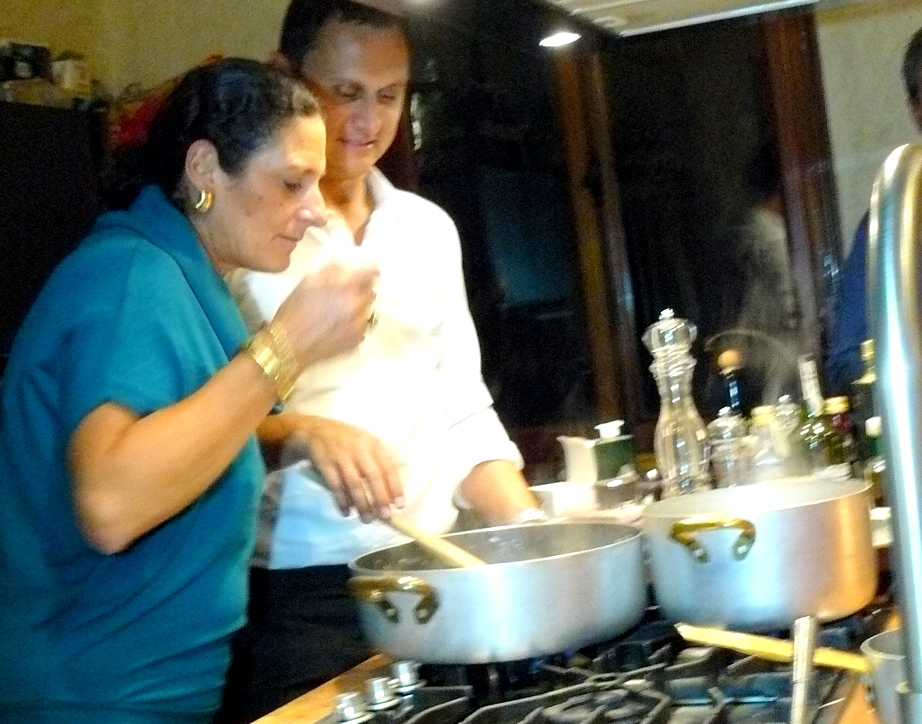
VENICE--Enrica Rocca, native of Venice, resident of London, returns to her handsomely appointed loft in the Dorsoduro and gives cooking pointers to paying guests. "The recipe," she says offhandedly, "is a modern concept."

Is this serious advice or another example of the Italian gift for stylish improvisation? "Just put good things in, good things will come out," she continues. Were this truly the case, she'd be out of work. But she continues: "The ingredient most often lacking is common sense."

And there, in a nutshell, is the reason for cookbooks, for the popularity of TV cooking shows and glamorous cooking-school vacations (a business I've got a stake in, truth be told): a lack, not just of common sense but of confidence.

We're in what used to be the laundry of her family palazzo, a short walk from the Accademia bridge. A butler in a tuxedo pours prosecco while Enrica and a couple of volunteers help with the risotto. Carnaroli, not arborio rice, two to three ounces per person. Put the porcini mushrooms in first, so their flavor penetrates the rice. Use stock made from prawn heads, where the flavor is. Add the prawns themselves at the last minute so they don't overcook. Stir in some wild mint and lemon zest, along with a touch of heavy cream, and let the risotto stand, covered, for five minutes before serving. We sit on stools covered with the hides of springboks, dyed bright orange, and the prosecco gives way to a Soave.

Karen Herbst w Marco Giol.JPG
We--a coterie of international tour operators--been invited to this impromptu dinner as part of a travel project called PLANETT, Private Luxury Accommodation Network, designed by Marco Giol (the very well-connected man with the motor launch described in this post) to showcase the very best of a private, hidden Venice that most tourists will never see:. a private palazzo on the Grand Canal, a private castello in the vineyards, that sort of thing.

Enrica worries about culinary programs that promsie to teach "how to cook" in one day. ("Pretentious bullshit.") Instead, four basics: qualty ingredients, take the time to shop, read the labels, and remember that the very act of eating is fundamental. Then go fot it. "And if you fuck it up, that's what takeout is for."

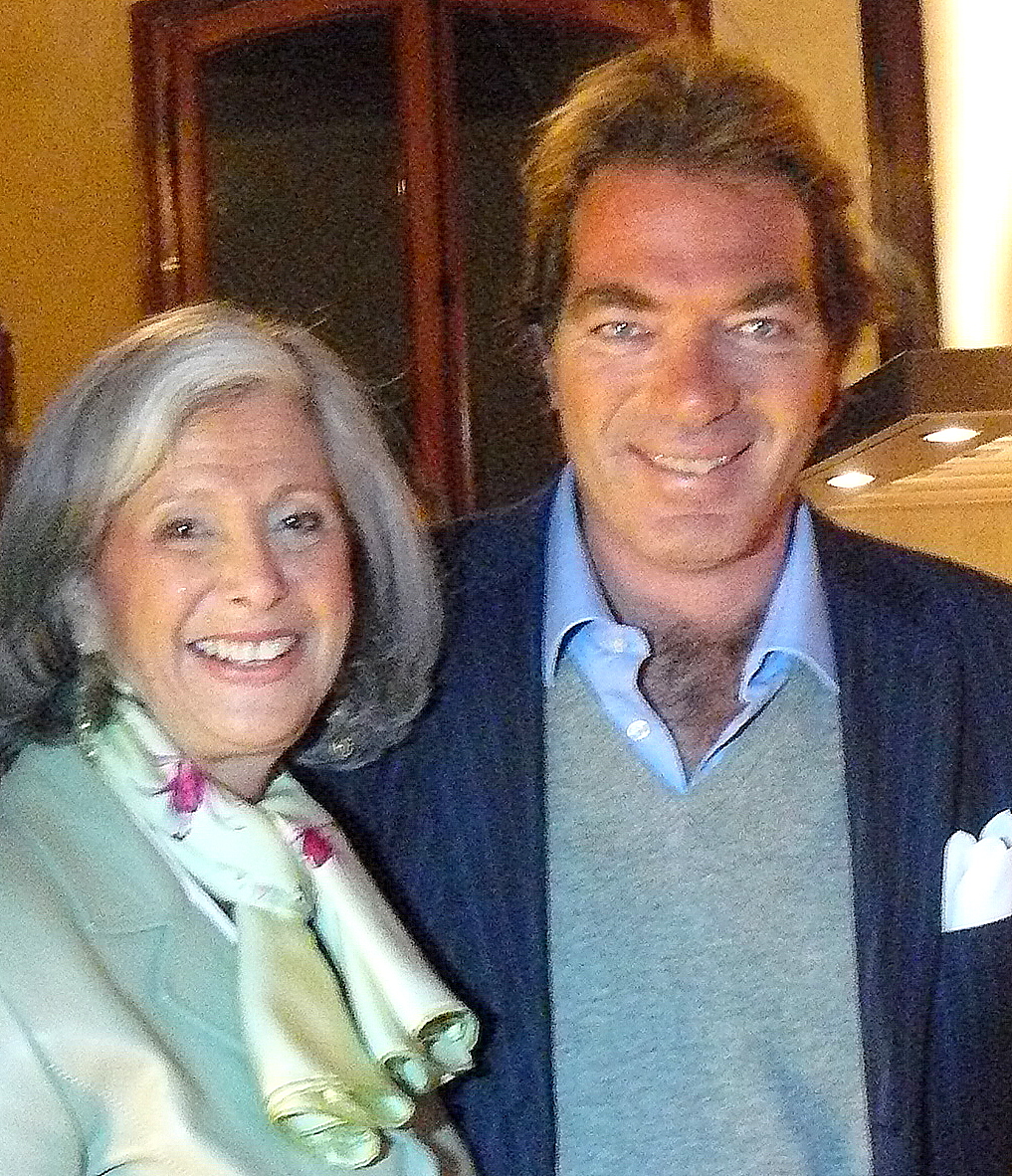
Top: Enrica Rocca checks the risotto. above, Marco Giol with Karen Herbst of The International Kitchen.

Monday, October 17, 2011

Italy in Mind

Sunday lunch at a farmhouse in the countryside 90 minutes southeast of Rome. It's almost a cliché, a scene you've watched in countless movies; just close your eyes and imagine the scene.


There are long tables under a pergola, there is sunshine, there is a medieval hilltop village in the distance. There is music (a gent playing a rustic bagpipe called zampogna), there is the cheerful sound of children playing soccer, there is wine, and, of course, there is food. A seemingly endless procession of food!

Assorted antipasto plates to start: slices of prosciutto and coppa, fresh ricotta, an older ricotta salata, home-baked bread, roasted peppers, a frittata, a potato salad, grilled eggplant, bruschetta with fresh tomatoes, bruschetta with arugula and cheese, cannellini beans...I confess to losing track.

Then comes pasta. Pacchetti (wide noodles stuffed with cheese, baked in the oven), strozzapreti amatriciana (thick noodles--priest stranglers--in a tomato sauce with guanciale, pork jowl), oricchietti (shell-shaped pasta) with artichoke hearts.


Then a couple of local specialties, braised goat (utterly delicious) and lumache, snails in tomato sauce (you pull the meat out with a toothpick).

Finally, some cookies for dessert. This was at an agriturismo (farmhouse inn, two guest rooms and a restaurant that uses almost exclusively the production of its own land) called Il Rusponte.

The price for the feast, which included a carafe of house red and a shot of house-made grappa with the coffee, all served by cheerful waitresses, was 35 euros per person (about $50), everything included. If you'd had a similar meal in a big-city restaurant, you'd pay three or four times as much.

The zampogna guy, on the other hand, was freelance. He showed up and played for the fun of it, then passed around his hat. Wake up? Surprise, you were awake the whole time!

- Posted using BlogPress from my iPad

Saturday, October 8, 2011

Harvest Dinner in Italy

Seems like everybody's opening a restaurant this month in Seattle, and everybody who's already got a restaurant is promoting a harvest dinner. You want a real harvest dinner? Try this: a seven-course game, truffle & mushroom feast.

What's the big deal, you might ask? Well, here's the translation:
  • crostini with mushroom & game pâté
  • egg & parmesan flan with black truffles
  • pasta with more truffles
  • risotto with porcini
  • roast suckling pig with forest mushrooms
  • wild strawberry tart
  • coffee with homemade liqueurs. 
The price: 30 euros (about $40, tax, tip and five wines included).

It's being held at the restaurant of a working farm, the Borgo del Riso, in the fertile Po River Valley 20 miles outside Bologna. Might be too late to get there this season, unless you don't mind shelling out two grand in last-minute airfares, but the rooms are only $65 a night once you arrive. And there's a lot to see nearby: the gorgeous "art cities" of Emilia-Romagna, Parmigiano dairies, Prosciutto farms, and one of the world's largest radio telescopes.

Some of those sights below, from a trip with the Italian Tourism Promotion Council back in 2006.

Me, I'm actually going to this one in Lazio, a cooking school called Casa Gregorio, an hour outside of Rome, next week. Promise to keep you posted.

Wheel of Parmigiano cheese
Baptistry ceiling in Bologna

Sunday, September 25, 2011

Historic gnocchi at Festa Italiana

Two strands to this story. One is current, Rossella Rago's "Cooking With Nonna" website and TV show. The other is historic, involving Sicily and Garibaldi.

Garibaldi is a hero in Italy, the military commander who, in 1861, "unified" the 20 regions of Italy and helped create the modern state. He's especially beloved in Sicily, for it was a single victory at the western port city of Marsala that made his reputation.

The strands came together this afternoon, when Enza Sorrentino, a native of Marsala, took the stage at the annual Festa Italiana at Seattle Center and prepared red, white and green gnocchi, the colors of the Italian flag.

Her restaurant on Queen Anne, Enza Cucina Siciliana, had come to the attention of Rossella, whose real mother and grandmother had helped her win an episode of the Food Network's "24 Hour Restaurant Battle" earlier this year. So Rossella made Enza, who has five grandchildren of her own, her honorary nonna of the day.

So there we have it: potato gnocchi rolled out, flavored and cooked in the space of half an hour.

The most remarkable thing may be that Rossella is only 23. She has poise and wit, charm and an unflappable stage presence, and, even more appealing, a profound respect for the wisdom of grandmothers everywhere. We're going to see a lot more of her.

- Posted using BlogPress from my iPad

Monday, September 19, 2011

My Sandwich, Your Sandwich


There's a sandwich shop in Manhattan called Pane Panelle, and their signature sandwich, a bun stuffed with chickpea fritters, is the one that inspired the name of this blog.

We know that there's more to sandwiches than ham on rye, more than even the fanciest, shmanciest burger. (In case we forgot, the Wall Street Journal this morning had a terrific reminder of great sandwiches around the country.) The street food of Sicily, or Vietnam, even a  New Orleans po'boy: that's where the flavor is.

The sandwich in the picture? From a vendor in the Vucceria market of Palermo, Sicily. It's spleen. Like all organ meats, full of goodness.